Freezer vs Fridge: How They Differ, Why One Side Fails First, and Which Repair You Need
SAAD MAAZ Technical Team
Saad Maaz Technical Services, Naif, Deira • Updated November 15, 2026 • 7 Min Read
Quick Answer
A fridge and a freezer do two jobs: the fridge holds 3–5°C for food, while the freezer holds −18°C to stop bacteria and preserve food for months. In most units one compressor and evaporator make the cold in the freezer, and a fan shares it with the fridge — which is why faults appear in one side first.
Guide Directory (Jump to Section)
- 1. The Temperature Difference — and Why It Exists
- 2. How One System Cools Both Compartments
- 3. Faults That Show in the Freezer First
- 4. Faults That Show in the Fridge First
- 5. Faults That Hit Both Sides Together
- 6. Standalone Freezers Are a Different Animal
- 7. Which Repair Applies — Symptom to Fix
- Frequently Asked Questions
1. The Temperature Difference — and Why It Exists
The fridge compartment is a cool box, not a cold box. At 3–5°C, bacteria grow slowly enough that milk, cooked food and vegetables keep safely for days, while delicate food is not damaged by freezing. The freezer at −18°C effectively pauses bacteria altogether, which is why frozen food keeps for months. Set either side wrong and you pay for it: a fridge dialled below 2°C wastes electricity and freezes lettuce and eggs at the back; a freezer allowed to drift up to −12°C still feels cold to your hand but is quietly shortening the safe life of everything in it. In a Dubai summer, when kitchen temperatures climb, both compartments work harder — which is when marginal parts start to fail.
2. How One System Cools Both Compartments
Here is the part most owners never get told: in the majority of combined fridge-freezers there is only one cooling system. The evaporator coil — the part that actually gets cold — sits in the freezer. A small fan blows air across that coil and pushes most of the cold air around the freezer, while a portion is ducted through a vent, controlled by a damper flap, into the fridge compartment. The fridge has no cooling parts of its own in these designs; it borrows cold from the freezer. That single fact explains almost every confusing fridge symptom: the two compartments share one compressor, one coil and one fan, so a fault in a shared part can starve one side while the other still feels fine. Separate systems with two compressors exist on some large premium models, but they are the exception in UAE homes.
One Side Warm?
That pattern is the diagnosis half done. We test the shared system and fix the actual part — diagnosis AED 50, waived with repair.
3. Faults That Show in the Freezer First
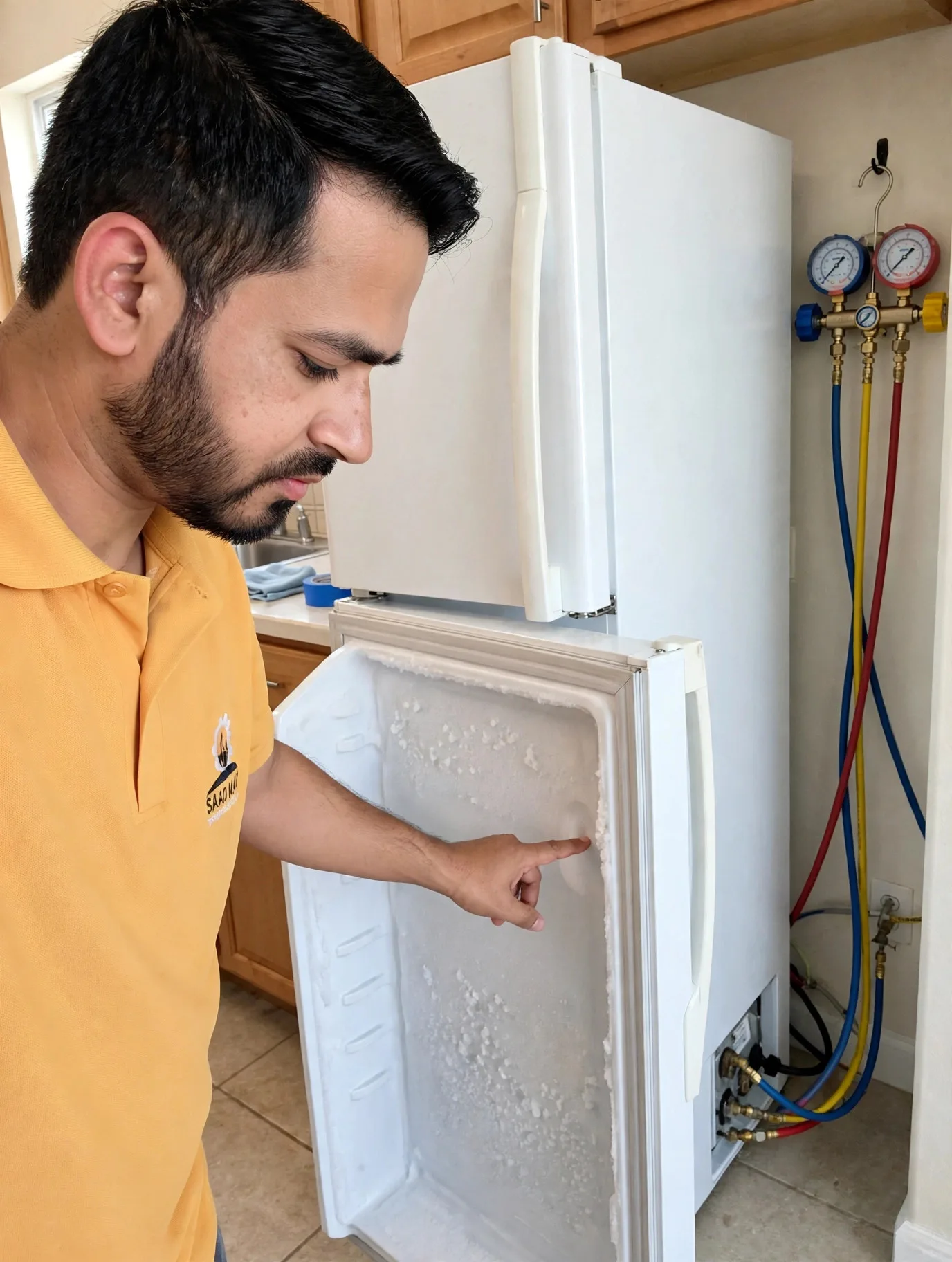
Because the cold is made in the freezer, freezer-side faults are usually system faults. Heavy frost on the freezer's back wall means the defrost system has failed — the ice slowly blocks the coil and the fan, and the freezer stops reaching −18°C even though it still feels cold. A failed evaporator fan motor (AED 200–450 to replace) means cold air is made but never circulated, so the freezer warms first and the fridge follows. A weak compressor or low refrigerant shows in the freezer first too, because −18°C is the harder target: the fridge may hold 5°C for days on a system that can no longer reach deep cold. Our freezer not freezing guide walks through these causes one by one, including the two checks to do before you call anyone.
4. Faults That Show in the Fridge First
The classic call-out — "the freezer is fine but the fridge is warm" — is almost never a cooling-system failure. It is an air-delivery problem. The vent between the compartments gets blocked by food pushed against the back wall, the damper flap sticks shut or its control fails, or frost from a defrost fault chokes the duct. The freezer keeps making cold; the fridge simply stops receiving its share. That is why the first check costs nothing: move food away from the vents and confirm the fridge is not packed so tightly that air cannot circulate. If the airflow is clear and the fridge still warms, the fan and damper are what a technician tests — a very different, and cheaper, job than the compressor work owners usually fear.
5. Faults That Hit Both Sides Together
When both compartments warm up at roughly the same speed, suspect the shared heart of the system. A failed start relay (AED 99–199) or a failed compressor (AED 350–800) stops all cooling everywhere at once — the clicking pattern that goes with it is explained in our fridge compressor cost guide. A refrigerant leak does the same more slowly, weakening both sides over days or weeks; gas refill (AED 150–350) is only ever done after the leak is found and repaired, never as a standalone fix. A failed control board (AED 250–600) can imitate almost anything, which is why it is proven by testing, not guessed. And the humble door gasket belongs on this list too: a seal leaking on either door makes the shared system run constantly, ageing every part at once.
6. Standalone Freezers Are a Different Animal
A chest freezer or upright standalone freezer is simpler than a fridge-freezer: in many models there is no fan and no damper — the cold coils are built into the walls, and cold air simply sinks and settles. Fewer moving parts means fewer faults, and the common ones are the compressor, the thermostat and the door or lid seal. The trade-off is diagnosis by temperature pattern: a chest freezer that cools at the top but not the bottom, or frosts heavily on one wall, is telling you about refrigerant or insulation, not airflow. Repair pricing follows the same fridge canon — relay AED 99–199, compressor AED 350–800 — and our freezer repair team works from the same diagnosis-first rule: AED 50, waived when you proceed with the repair.
7. Which Repair Applies — Symptom to Fix
| Symptom | Side affected | Most likely cause | Typical repair (Dubai) |
|---|---|---|---|
| Freezer warm, fridge normal | Freezer | Defrost failure or fan motor | Defrost part test; fan motor AED 200–450 |
| Fridge warm, freezer normal | Fridge | Blocked vent or damper fault | Clear airflow; damper/fan repair quoted after diagnosis |
| Both warm, clicking sounds | Both | Start relay or compressor | Relay AED 99–199; compressor AED 350–800 |
| Both warm, slowly over weeks | Both | Refrigerant leak | Leak repair + gas refill AED 150–350 |
| Fridge cold, freezer soft ice cream | Freezer first | Weak compressor, dirty coils or fan | Diagnosis decides; coil clean in annual maintenance AED 149 |
| Water under the unit | Either | Blocked defrost drain | Drain cleared at diagnosis visit |
Every row starts the same way in our workshop: diagnosis first (AED 50, waived with repair), because the same symptom can sit in two different price rows until the part is tested. Based in Naif, we cover Deira — Al Rigga, Al Muteena, Al Baraha and Al Muraqqabat — 24 hours a day, with typical response in 30 to 45 minutes, and replaced parts carry a 3 to 12 month warranty.
Frequently Asked Questions
Why is my freezer cold but the fridge warm?
Almost always air delivery, not cooling: the vent or damper between the compartments is blocked or has failed, or frost is choking the duct. Check that food is not pushed against the back vents first — that free check fixes a surprising number of cases.
Why is my fridge cold but the freezer not freezing?
The freezer has the harder job (−18°C), so a weakening shared system — dirty coils, a tired fan, low refrigerant or a compressor losing strength — fails there first while the fridge still holds 5°C. Our freezer not freezing guide lists the seven causes in order.
Can the freezer and fridge be repaired separately?
In most combined units they share one compressor, coil and fan, so one repair usually restores both sides. Only truly separate dual-compressor models can be repaired one system at a time.
What temperature should I set my fridge and freezer to in Dubai?
3–5°C for the fridge and −18°C for the freezer. In the hottest months avoid opening doors longer than needed, and let hot food cool before it goes in — both habits measurably reduce how hard the system works.
One side warm and the other fine? That pattern is the diagnosis half done. Call or WhatsApp +971 50 826 8637 — Saad Maaz Technical Services, Naif, Deira. Diagnosis AED 50, waived with repair.