Washing Machine Leaking Water? Where the Leak Comes From and How It Is Fixed
SAAD MAAZ Technical Team
Saad Maaz Technical Services, Naif, Deira • Updated November 15, 2026 • 6 Min Read
Quick Answer
A washing machine leak usually comes from a split or loose inlet or drain hose, a worn door gasket on front-load models, a leaking drain pump, or too much detergent foaming through the dispenser. Where the puddle sits tells you the source: front leaks point to the door seal, rear leaks to hoses.
Guide Directory (Jump to Section)
- 1. First, Make It Safe and Stop the Water
- 2. Read the Puddle — What the Leak Location Tells You
- 3. Check 1 — Hoses and Connections at the Back
- 4. Check 2 — The Door Gasket on Front-Load Machines
- 5. Check 3 — Detergent, Foam and Overloading
- 6. When the Leak Is Inside the Machine
- 7. How Much Does It Cost to Fix a Washing Machine Leak in Dubai?
- Frequently Asked Questions
1. First, Make It Safe and Stop the Water
Switch the machine off at the wall and unplug it. Water and electricity never mix, and a leaking machine should not run another cycle until you know where the water is escaping. Close the water tap feeding the machine — it is usually on the wall behind it. Mop up the puddle so it does not spread under flooring or into the wall, which matters in Dubai apartments where a slow leak can damage the flat below. Then note one detail before you touch anything else: when does the leak happen? A leak that appears while the machine fills, while it drains, or only during the spin points at three different parts, and that timing is the single most useful clue you can give a technician.
2. Read the Puddle — What the Leak Location Tells You
Water at the front of a front-load machine usually comes from the door area: the rubber gasket, the dispenser drawer above it, or detergent foam escaping past the seal. Water behind the machine points to the plumbing — the inlet hose, its rubber washers, the water inlet valve, or the drain hose where it leaves the machine. Water directly underneath, spreading from the centre, usually means something inside has failed: the drain pump seals, an internal hose, or the tub seal. On a top-load machine there is no door gasket, so front puddles there usually mean oversudsing or a dispenser overflow. Matching the puddle to the area first saves you from dismantling the wrong part of the machine.
Water Under the Machine?
Do not run another cycle — water and electrics never mix. We find the leak and fix it in one visit across Deira, 24 hours a day. Diagnosis AED 50, waived with repair.
3. Check 1 — Hoses and Connections at the Back
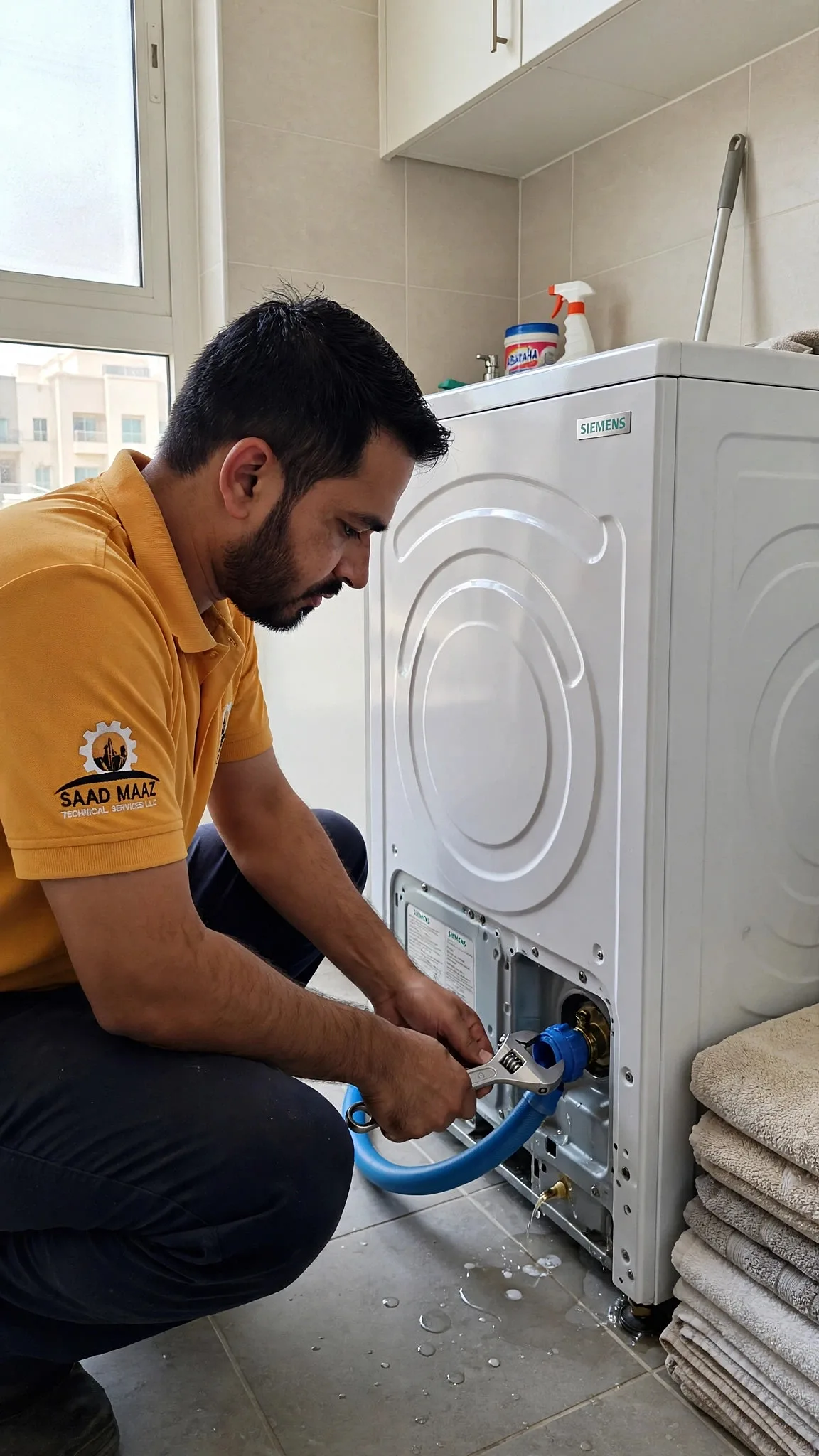
Pull the machine forward gently and shine a torch behind it. The inlet hose screws onto a wall tap and onto the machine's inlet valve; the rubber washer inside each connector hardens with age and starts to weep, and the hose itself can split where it bends. Run your fingers along every connection — a leak here is often a slow drip that only shows while the machine is filling, when the hose is under full mains pressure. Check the grey drain hose too: if it has been pushed too far down the standpipe, pulled partly out, or cracked at the bend, drain water spills behind the machine instead of going down the pipe. Tightening a connector by hand and reseating the drain hose fixes a surprising number of "leaks" without any parts at all.
4. Check 2 — The Door Gasket on Front-Load Machines
Open the door and fold back the grey rubber gasket. Look for tears, splits at the bottom fold, and the black mould that grows in Dubai's humidity when the door is kept shut between washes. A trapped sleeve or a coin left in a pocket can nick the seal, and even a small nick leaks under spin pressure. Wipe out the gasket folds and check the small drain holes at the bottom of the seal — when they clog with lint and sludge, water sits in the fold and spills over the front. A gasket that is torn or has gone hard needs replacement; a dirty one often just needs cleaning and the habit of leaving the door ajar after washes.
5. Check 3 — Detergent, Foam and Overloading
Too much detergent is a genuine leak cause, not a myth. Excess foam expands during the wash, climbs into the dispenser housing and the vent, and pushes soapy water out of the drawer and down the front of the machine. The puddle gives it away: it is foamy and appears early in the cycle. Use the dose marked for your load size, and remember that softened water and modern concentrated detergents need less than most people pour. Overloading does the same damage differently — a drum packed tight unbalances the machine, it shakes hard on the spin, and that shaking loosens hose connections and stresses the tub seal over time.
6. When the Leak Is Inside the Machine
If the hoses, gasket and detergent all check out and water still spreads from underneath, the fault is internal. The usual suspects are the drain pump, whose seals wear until it drips while pumping; an internal hose that has rubbed through or slipped off its clamp; the water inlet valve weeping at its solenoid body; and, on older machines, the main tub seal around the drum bearing. These are technician jobs — the cabinet has to come off and the part tested, not guessed. A drain pump replacement costs AED 150–250 including the part and labour. Hoses, seals and valves are quoted after diagnosis, because the part differs by brand and model — our diagnosis is AED 50, waived in full when you proceed with the repair, and replaced parts carry a 3 to 12 month warranty.
7. How Much Does It Cost to Fix a Washing Machine Leak in Dubai?
Honest answer: it depends which part is leaking, and anyone quoting a fixed price without seeing the machine is guessing. The costs you can rely on are these. Diagnosis is AED 50, waived when you go ahead with the repair. A blocked filter that is pushing water back is cleared as part of filter clearing at AED 99–150. Drain pump replacement is AED 150–250. Drum bearing and tub seal work — the biggest common leak job, because the drum has to come apart — is AED 350–600. Small parts such as hoses, washers and door gaskets are priced by model after diagnosis, and you approve the fixed quote before any work starts. Our team is based in Naif and covers Deira — Al Rigga, Al Muteena, Al Baraha and Al Muraqqabat — 24 hours a day, with typical response in 30 to 45 minutes.
Frequently Asked Questions
Why does my washing machine only leak during the spin cycle?
Spinning puts the tub and hoses under the most movement and pressure. A small gasket tear, a loose internal hose or a worn tub seal may hold during a gentle wash and only leak when the drum spins hard — especially with an unbalanced load.
Is a leaking washing machine safe to keep using?
No. Water reaching the motor or electrics can trip the breaker or damage the machine, and a slow leak rots flooring and can reach the flat below. Switch it off, close the tap, and get it checked.
Can too much detergent really make a washing machine leak?
Yes. Oversudsing foam escapes through the dispenser and vents and runs down the front. If the puddle is foamy and appears early in the cycle, halve your detergent dose and run a hot empty cycle before booking a repair.
Which areas do you cover for washing machine repair?
We are based in Naif, Deira and cover Al Rigga, Al Muteena, Al Baraha, Al Muraqqabat and nearby areas, 24 hours, 7 days, with typical response in 30 to 45 minutes.
Water under the machine? Do not run another cycle. Call or WhatsApp +971 50 826 8637 — Saad Maaz Technical Services, Naif, Deira. Diagnosis AED 50, waived with repair.